
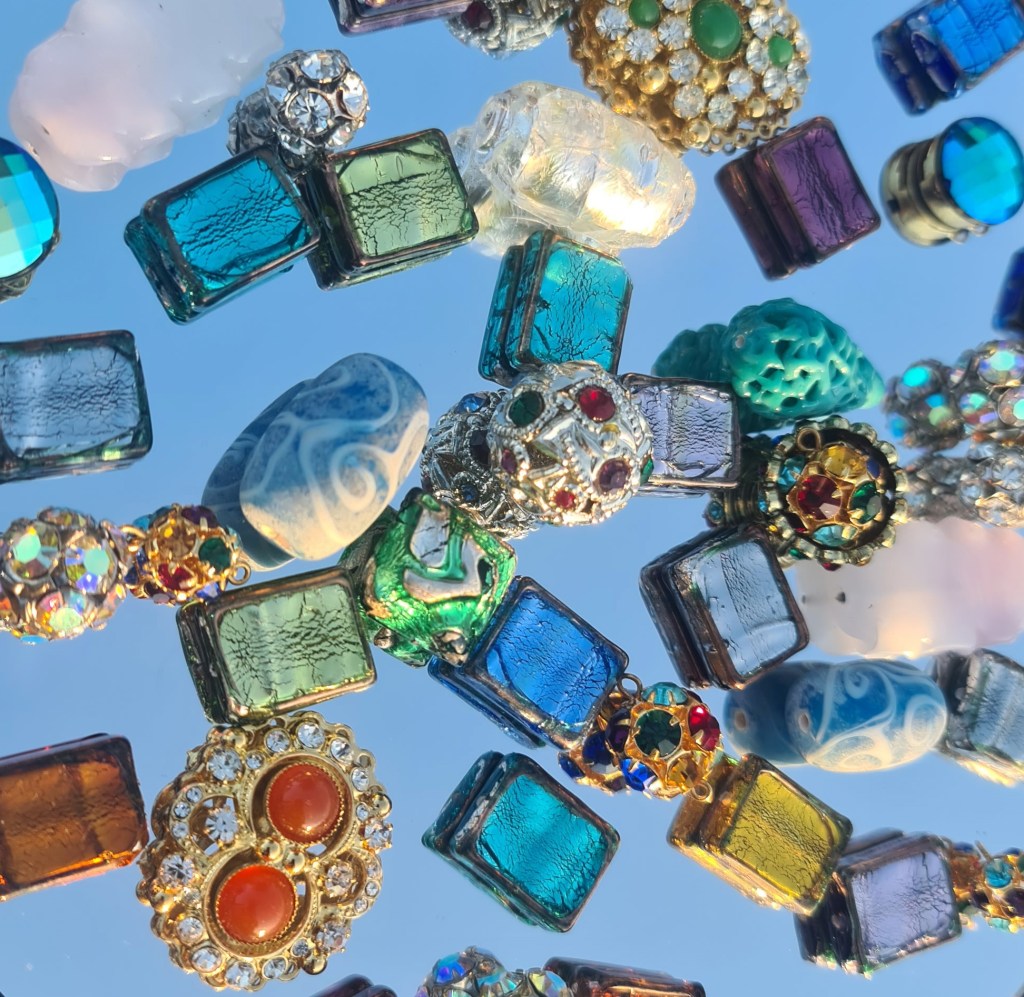
The Costume Society’s Conference Coordinator Amy Wilson reflects on our annual conference; Adorned with Jewels.
This year the Costume Society turned 60 and in our diamond anniversary year it seemed appropriate to celebrate with a bejewelled annual conference. Adorned with Jewels has been a fabulously popular and well attended highlight to the 2024 events programme. Split across 4 sessions in October and November we received papers from 14 speakers and Susan Rumfitt was invited to be our keynote speaker. Dr Karen Perlman was our highlight speaker having submitted the abstract which received the highest score from the review panel in our anonymised selection process. Our intention was to explore all things jewelled and encrusted with stones, bullion, metals, sequins and beads and fragments from the natural world. Our speakers were selected this year from an unprecedentedly large pool of applicants and responses to this brief were diverse and thought provoking. Keynote speaker Susan Rumfitt set the tone in session one with an analysis of jewels owned and worn by members of the British (and English) royal family. Beginning in Tudor England Susan considered royal jewellery as symbols of power, healing, good fortune and as tokens of love and affection. The theme of adornment as a mode of communication would be expanded on by several future speakers in the series. Rebecca Harvey joined us in session four and presented her work on a new National Trust project which aims to research and conserve a collection of jewels held at Calke Abbey. The jewels belonged to the Harpur Crewe family and the meaning and significance of some of the pieces were explained in touching detail. Rebecca and her team hope the collection will be on display in the future.
The significance of national and cultural identity was revisited at various point throughout this year’s conference series. The glass bead making industry in the region which forms modern-day Czech Republic was the subject of an excellent paper by Maria Ilinceva. Bohemian beads made in this region were sold first to the ancient Romans and since then have been found on Kenyan and Lacota national costume and on mangalsutra necklaces in India. Bohemia was once the largest exporter of beads in the world and today the traditional skills necessary to make Bohemian glass beads continue to be taught in a series of bead and jewellery making schools in the region. The costume making and decorating practices of Alaska Natives was the subject of Elisa Palomino’s paper in session three. With limited recourses Alaska Natives made clothing, accessories and decorative elements exclusively from fish. In this fascinating paper Elisa conveyed the way fish bones, bladders and skin formed utensils necessary for the making process. The intricate objects made in this way were then decorated with fish vertebrae and otoliths to beautiful effect. Meanwhile Dr Katja van der Steen gave a paper about the craftsmanship and techniques traditionally used to adorn Russian folk costume with pearls. While the shape and size of pearls varied by region Katja has also identified variation in the stringing and sewing techniques traditionally employed. Pearl embellishment with goldwork was typical for the costume of the ruling classes yet Katja’s research has shown that pearls could also be found in the traditional dress of Russian peasants and merchants. Metal embroidery is a form of adornment traditional to Indian textiles. Dr Vandana Bhandari’s paper explored the range of techniques used to produce gold and silver surface ornamentation in the traditional Indian textile industry. In the past Clothing embellished with precious metal was worn for ceremonial occasions by Indian elites, but more recently there has been a resurgence of metal-adorned textiles among twenty-first century fashion designers. In the nineteenth and early twentieth century visitors to Bethlehem collected traditional Bethlehem headdresses or Shatwe as souvenirs. The headdresses are tall and lined with coins, amulets and medallion. Wafa Ghnaim joined us in session two and presented her research of Shatwe in western museum collections. Wafa has analysed the ornamentation featured in Shatwe as a source of information about the lives and lived experiences of the people who made them.
Personal identity and self-expression formed a second theme richly represented throughout this year’s conference. Nathaniel Dafydd Beard explored pearl-wearing as an expression of masculine identity within historic and contemporary contexts. Fashion-leading celebrities, including Harry Styles and Timothée Chalamet, have been photographed in recent years wearing pearls. Nathaniel’s paper sited these modern examples of male pearl-wearing within a broad and long-established tradition with origins in antiquity. In session one we also heard from Lynne Bartlett who considered the practical and aesthetic properties of Chatelaines in eighteenth-century dress. She introduced evidence that men as well as women wore chatelaines prior to the nineteenth century and charted their popularity in relation to the fashion for clothing with pockets. Her work demonstrated that household objects worn on a chatelaine could be classed as adornments, while the same objects concealed in a pocket were not. Rowan Quinn’s paper brought to prominence the role of adornments within LGBT+ communities. His paper explored the significance of jewellery as an expression of sexual identity and the utility of traditional and non-traditional objects as forms of adornment. His work challenged the concept and the definition of jewels, and the image of a denim jacket adorned with safety-pins in the shape of angel wings illustrated this point with particular effectiveness. Self-fashioning and self-expression also formed the subject of Caela Castillo’s paper about the African bracelet collection of Nancy Cunard. Beginning in the 1920s socialite and writer Nancy Cunard collected several hundred bracelets of African origin in her lifetime and wore them regularly, eventually becoming a signature part of her public image. Caela handled with tact and sensitivity the challenges of a collection that intersects art, identity and cultural appropriation. The jewellery collections of Jane and May Morris formed the basis of a case study presented by session 4 speaker Megan Breckell. Jane Morris, wife of arts and crafts designer William Morris, and their daughter May used their jewellery as a form of agency and identity. Megan’s paper demonstrated, via rich and beautiful imagery, the function of jewellery in a process of artistic self-fashioning.
Several of our speakers considered the role of jewellery and adornments as a form of art. The history of buckles as embellishment were the subject of Shelley Tobin’s paper in session four. Shelley’s research is based on the collection of the Royal Albert Memorial Museum in Exeter and her paper includes an examination of materials, designs and uses for buckles beginning in the seventeenth century. In session three we were joined by Dr Karen Perlman our highlight speaker. Her paper on the work of Albert Lesage and the Maison Lesage championed the pioneering creativity of this celebrated early twentieth century embroiderer. Karen’s beautifully illustrated paper explored the diverse work Lesage produced for his clients including Madeleine Vionnet and Elsa Schiaparelli. In session three we were also joined by Maria Pardos-Mansilla who provided a detailed account of the conservation work recently completed on a costume worn by the celebrated Victorian actress Ellen Terry. The ‘Beetle Wing’ dress worn by Terry in a production of Macbeth had become fragile and damaged over time. Maria explained the work she and the team at the National Trust Textile Conservation Studio have completed to conserve the dress in beautiful detail and prepared it for display.
Dauvit Alexander gave a thought-provoking paper about a project which saw knives transformed into jewellery. His creative practice is a response to knife crime in the United Kingdom and forms part of a nationwide touring exhibition Swords Into Ploughshares: Knives Into Jewels. Dauvit considered the practical and symbolic use of knives as a raw material in jewellery making, but also the role the arts can play in addressing social and cultural challenges. Dauvit’s paper and the story of his work will stay with me for a long time to come. During the four sessions of this year’s conference we witnessed examples of textile adornment and jewellery from different ages and different parts of the world. Some of the jewels were near-priceless in monetary terms and others were very humble. Yet it was the meaning, symbolism and artistry behind sartorial ornamentation which became the main message of this, our diamond anniversary conference.
I adorned you with ornaments, put bracelets on your wrists, and a chain on your neck. And I put a jewel in your nose, earrings in your ears, and a beautiful crown on your head. Thus you were adorned with gold and silver, and your clothing was of fine linen, silk, and embroidered cloth.
King James Bible Ezekiel 16:11-14
 Amy Wilson